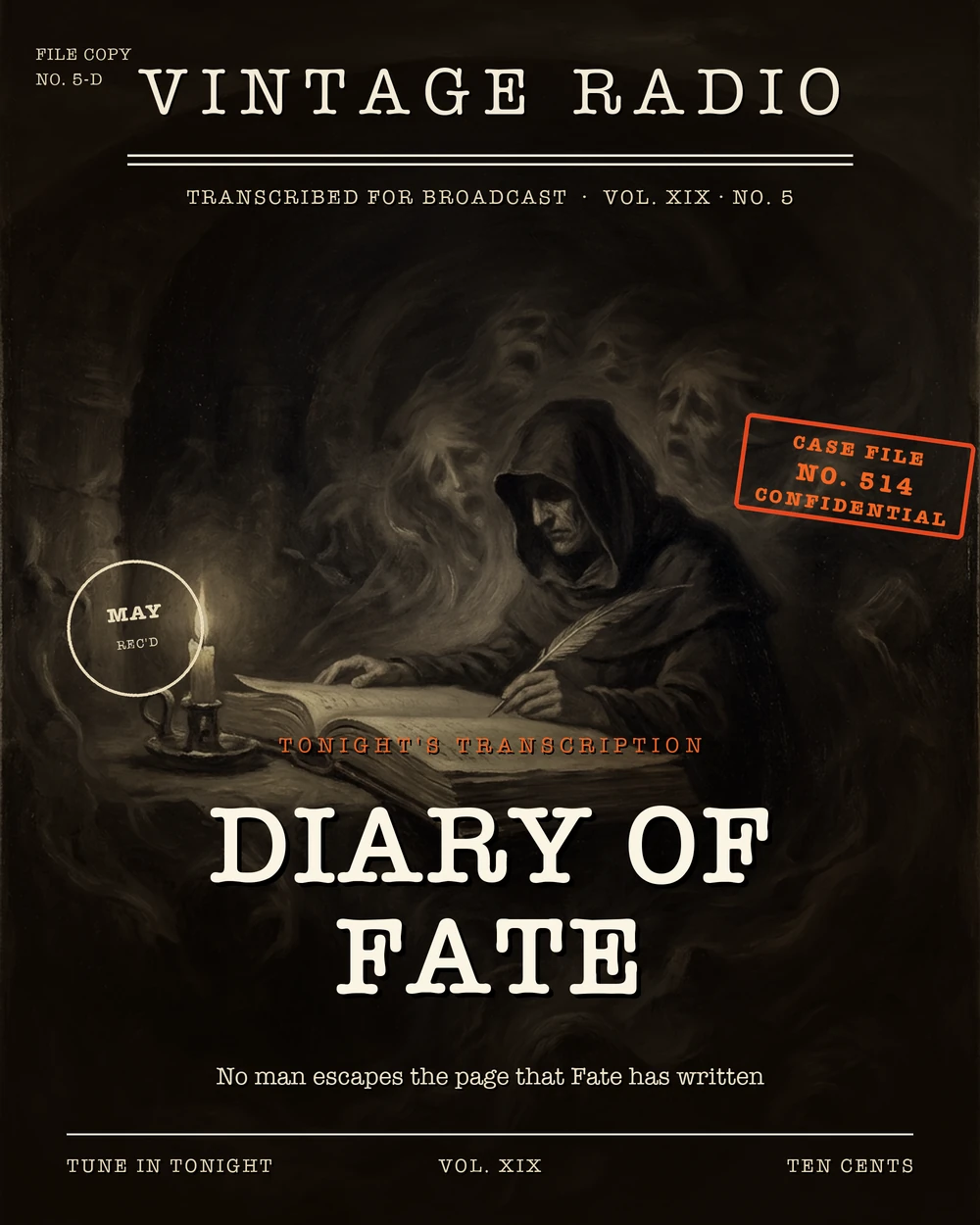
Diary of Fate
Fate Plays No Favorites
The premise of Diary of Fate was simple and unforgiving: every episode followed a criminal, a schemer, or a murderer, and every episode ended the same way — with that person caught and punished. No exceptions, no redemptions, no last-minute reprieves. The show's tagline said it plainly: "Fate plays no favorites… it could happen to YOU!" and the in-show catchphrase reinforced it — "in which FATE narrates, and always wins." That formula, a morality-play structure dressed in horror trappings, was the engine that drove the entire series.
The show originated at KECA in Los Angeles on the ABC network, produced by Larry Finley through his Finley syndication operation. Because it was syndicated, individual stations could air episodes on any date and in any order, meaning the show reached different audiences at different times throughout its run. The first episode in the ABC/KECA feed, titled "The Entry of Charles Elliot," carried a broadcast date of December 15, 1947, though most catalog records place the series in the February–August 1948 window.
The Voice of Fate
Co-producer Herb Lytton played the central narrator himself — a character simply called Fate. Lytton was a working Hollywood radio actor with credits on Lux Radio Theatre and The Whistler, and was known in the industry for an unusual skill: he could read scripts cold, without mistakes, on the first pass. That kind of technical polish was valuable in live radio production. He was also active in television through the 1950s and into the early 1960s.
As Fate, Lytton opened each episode with the sound of a creaking door, then introduced a new entry from his diary — one ordinary person's story, already written, already decided. At the end of each episode, Fate closed the diary and the creaking door sounded again. It was a tight, economical frame, and the bookend structure gave the series a consistent identity across its run. The Joe Hehn Memorial Collection notes, however, are candid about how Lytton's performance landed: they describe the narrator's voice as "wooden" and "hard to accept other than as a caricature." Whether that quality worked against the show or simply defined its particular flavor is a matter of taste, but it's a fair description of what made Fate feel less like a credible presence and more like a stylized device.
What the Show Actually Was
Despite later descriptions that reached for terms like "existential horror" and "the supernatural," Diary of Fate was not a supernatural program. The Joe Hehn Memorial Collection notes are explicit on this point, comparing it to Murder at Midnight — but specifically noting it lacked Murder at Midnight's supernatural elements. The show's plots concerned ordinary criminals: people who schemed, lied, committed crimes, and made fatal moral choices. Their punishment came from earthly sources, not otherworldly ones. Fate won because the characters' own actions trapped them, not because of any paranormal intervention.
This places the series closer to the crime-and-mystery morality-play tradition than to horror in any supernatural sense. The horror classification reflects tone and atmosphere — the creaking door, the omnipotent narrator, the sense of dread and inevitability — rather than content. One source at mysteryfile.com captures the distinction neatly, describing Fate as "judgmental and uncaring," which sets it apart from the warmer, more sympathetic host-narrator formats found elsewhere in the genre. Fate didn't explain why bad things happened to people; Fate just recorded it, without comment or consolation. A structural comparison that holds up is Mutual's The Sealed Book, which used a similar omniscient-narrator device, but Diary of Fate leaned harder into the idea that its characters had no possibility of redemption — they had made their choices, and the ledger was already closed.
The People Behind It
The supporting cast was drawn from the pool of Hollywood radio talent working in Los Angeles at the time. Gloria Blondell, Jerry Hausner, Virginia Gregg, Ruth Perrott, Herbert Rawlinson, Tyler McVey, Hal Sawyer, Howard McNear, Barney Phillips, Tom Brown, David Ellis, Daws Butler, and Byron Kane all appeared in episodes. That's a recognizable roster for anyone familiar with 1940s West Coast radio production — several of these performers went on to substantial careers in television and continued radio work throughout the decade.
Sound effects were handled by Ray Ehrlenborn, who would go on to become a significant figure in radio drama for his work on Gunsmoke. Organ music was provided by Ivan Ditmars. Producer Larry Finley, who was born in Syracuse, New York, in 1913, operated KSDJ in San Diego and later attempted to launch the Progressive Broadcasting Systems network, which ran briefly from August 1950 to January 1951 before folding.
The episode titles themselves were almost all proper names — "Henrick Potenoff," "Craig Norton," "Albert Ricker," "Tyler White," "Darrell James," and so on through the 24 episodes in the catalog. Each title named the protagonist whose story Fate was recording, reinforcing the diary conceit: these were entries about specific individuals, their choices, and their inevitable ends.
How It Was Received — And How It Wasn't
Diary of Fate was not a show that made the standard reference works, and the Joe Hehn Memorial Collection notes — one of the more substantive sources on the series — are direct about why: its absence from the major radio histories "was no accident." The stories are described as "not the best," and the notes observe that "most collectors never took the program seriously."
That's a candid assessment, and it matches the show's general standing. Diary of Fate ran for roughly six months across 24 episodes before ending on August 10, 1948. It was a modestly budgeted syndicated production that found its format, stuck to it, and didn't vary much. The formula — criminal protagonist, morality-play justice, omnipotent narrator — worked well enough to fill the run, but it didn't generate the kind of critical enthusiasm that kept other anthology series in the conversation for decades afterward.
What the series does represent is a clear and consistent example of the late-1940s syndicated anthology format: morally simple, efficiently produced, designed to fill a half-hour slot with a story that arrived and resolved without loose ends. For listeners who found the period's anxieties about fate and consequences reflected in that kind of story, it filled a specific niche. The 24 surviving episodes remain a document of how that niche was served.